
Two people, same height, same weight, same office job, eating the same number of calories, can burn energy at rates differing by up to 2,000 calories a day.
Not because of thyroid function. Not because of the genetics people usually mean. The explanation is a category of movement most people never think about — and never log in a fitness app.
Quick Fact: In a Mayo Clinic study, 16 adults were overfed 1,000 extra calories daily for eight weeks. Fat gain varied tenfold between participants. The best predictor of who stayed lean wasn’t willpower or exercise — it was how much their unconscious daily movement increased, ranging from -98 to +692 calories per day across the group.
What NEAT Actually Is
NEAT stands for non-exercise activity thermogenesis — the energy you burn doing everything that isn’t sleeping, eating, or deliberate exercise.
That covers a lot: walking to your car, standing while you cook, carrying groceries, doing laundry, pacing during a phone call, fidgeting at your desk, typing, yard work, tidying up, taking stairs.
Your total daily energy expenditure breaks into four components:
- Basal metabolic rate — keeping you alive at rest (roughly 60-70% of total)
- Thermic effect of food — digesting what you eat (roughly 10%)
- Exercise activity thermogenesis — deliberate workouts
- NEAT — everything else you do while awake
Here’s the part that reframes things: for most people, exercise is the smallest of those categories. Even among people who exercise 1-2 hours weekly, structured workouts account for roughly 100 calories per day averaged out. NEAT can account for 300 to 1,000+ calories.
Quick Reference: Where Your Daily Calories Go
| Component | Typical Share of Daily Burn | Variability Between People |
|---|---|---|
| Basal metabolic rate | 60–70% | Moderate |
| Thermic effect of food | ~10% | Low |
| Exercise (structured) | ~5% for most people | Low to moderate |
| NEAT | 15–30% | Very high — up to 2,000 kcal/day |
Why Sitting Time Is the Real Variable
Levine’s follow-up research found something specific and actionable: adults with obesity sat an average of 2.5 hours more per day than lean adults with similar sedentary jobs.
The lean group wasn’t exercising more. They were simply upright more — standing, puttering, moving between tasks. The researchers estimated that if the sitting group adopted the standing-and-moving pattern of the lean group, they would expend roughly 350 additional calories per day.
That’s a meaningful number without a single workout added.
The Dieting Problem Nobody Warns You About
This is the finding that explains one of the most frustrating patterns in weight loss.
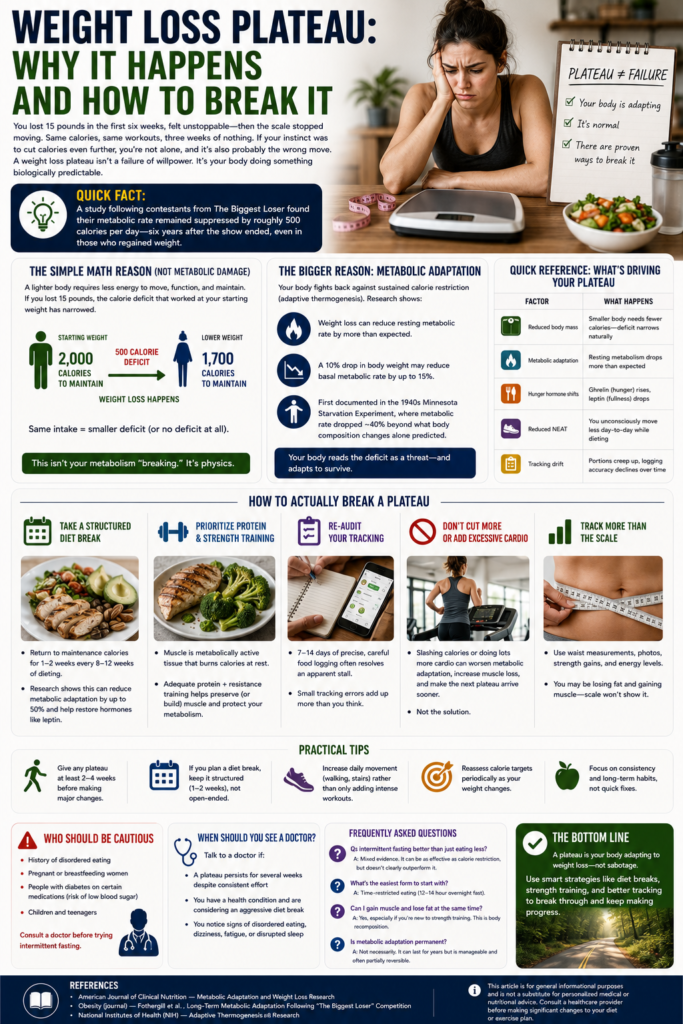
When you cut calories, your body compensates — and one of the first places it economizes is NEAT. Estimates suggest NEAT drops by 200-400 calories per day during calorie restriction.
Crucially, this happens unconsciously. You don’t decide to move less. You take the elevator without thinking about it, sit through a phone call you’d normally pace during, fidget less, stand less. The deficit you carefully calculated quietly shrinks by a few hundred calories while your food intake stays exactly where you planned it.
This is a major contributor to why weight loss slows even when tracking stays accurate — and it’s why deliberately protecting daily movement during a deficit matters more than it seems.
Why NEAT Beats Adding More Cardio
For someone trying to lose fat, adding NEAT has several practical advantages over adding another workout:
No recovery cost. Extra cardio competes with strength training for recovery capacity. Walking more doesn’t.
Sustainable indefinitely. You can maintain a high-movement lifestyle for years. Most people can’t sustain an aggressive cardio schedule that long.
No scheduling required. NEAT doesn’t need a time block, a gym, or a change of clothes.
It compounds. Going from 5,000 to 10,000 steps daily is roughly 200-250 extra calories — every day, without a single “workout.”
What People Actually Notice
The most common realization when people start paying attention to NEAT isn’t about calories. It’s about how sedentary a normal day actually is.
The suggestion that helps most is deceptively simple: write out your typical day hour by hour, and mark which hours are seated. Most people are genuinely surprised by the ratio — often 70% or more of waking hours spent sitting, even on days that felt reasonably active.
The second common pattern is exercise compensation: being noticeably more sedentary on days you work out. Someone finishes a hard gym session and then spends the rest of the day on the couch, netting out lower total movement than an ordinary day. The workout gets logged; the eight sedentary hours afterward don’t.
There’s also an environmental piece worth naming. Levine’s argument was that the obesity epidemic partly reflects a “chair-enticing environment” — desks, cars, screens, delivery. NEAT isn’t purely a willpower issue; it’s substantially shaped by how your day is physically structured. Which means changing the structure often works better than trying harder within it.
Common Mistakes
Only counting logged workouts. If your fitness tracker shows a 45-minute session and nothing else, you’re seeing maybe 15% of your activity-related burn.
Compensating after exercise. Being extra sedentary post-workout can cancel much of the calorie benefit. The workout is a bonus on top of an active day, not a substitute for one.
All-or-nothing thinking. Believing that if you can’t get to the gym, movement doesn’t count. NEAT is precisely the category where small, unglamorous movement adds up.
Letting NEAT collapse during a diet. The unconscious drop of 200-400 calories daily is one of the least-discussed reasons deficits stall. Tracking steps during a cut catches it.
Trying to fix it with one big change. Buying a standing desk and using it two hours a day helps, but so does taking stairs, parking further away, and pacing on calls. The compounding comes from many small defaults, not one purchase.
Assuming fidgeting is trivial. In the overfeeding research, small spontaneous movements were a meaningful part of what separated the people who stayed lean from those who gained.
Practical Tips
- Track your daily steps for one week without changing anything, to establish an honest baseline before setting a target.
- Attach movement to things you already do — pace during phone calls, stand while watching TV, walk while listening to podcasts.
- Watch your step count specifically during a calorie deficit; a quiet decline is the compensation effect in action.
- Redesign defaults rather than relying on motivation: park at the far end, take stairs by default, keep the printer across the room.
- Alternate sitting and standing every 30-60 minutes if you have a desk job, rather than standing for one long block.
If you’re building a complete plan, it’s worth pairing this with our guides on calorie deficit explained and how many steps a day you actually need, since NEAT is where most of the gap between calculated and actual expenditure lives.
When Should You See a Doctor?
Check with a doctor before significantly increasing daily activity if you have joint problems, cardiovascular disease, balance issues, or have been sedentary for an extended period. Also worth raising: if you’re maintaining a consistent calorie deficit and tracking accurately but weight loss has stalled for more than several weeks, since compensatory changes in energy expenditure may be part of the picture.
Frequently Asked Questions
How many calories does NEAT actually burn? It varies enormously — typically 15-30% of total daily energy expenditure, with differences between individuals of similar size reaching up to 2,000 calories per day depending on occupation and lifestyle.
Is NEAT more important than exercise for weight loss? For most people, NEAT accounts for far more daily energy expenditure than structured exercise does. Both matter, but NEAT is the larger and more variable component for the majority of people.
Does NEAT decrease when I’m dieting? Yes, and usually without you noticing. Estimates suggest a drop of 200-400 calories per day during calorie restriction, driven by unconscious reductions in spontaneous movement.
Can fidgeting really make a difference? In overfeeding research, increases in spontaneous movement including fidgeting were the strongest predictor of who resisted fat gain, with variation across participants spanning nearly 700 calories per day.
The Bottom Line
The gap between two people’s daily calorie burn is usually not metabolism in the way people mean it — it’s movement that never gets counted as exercise. NEAT is the largest variable component of daily expenditure for most people, it quietly declines during dieting, and it responds better to changing your environment’s defaults than to trying harder. The stairs, the walk to the far parking spot, the pacing during a call: those are the calories nobody is tracking.
This article is for general informational purposes and is not a substitute for personalized medical or fitness advice. Consult a healthcare provider before significantly increasing your activity level, especially if you have an existing health condition.
References
- Mayo Clinic Proceedings — Nonexercise Activity Thermogenesis in Obesity Management
- Harvard Health — Use the NEAT Factor to Burn Calories
- Cleveland Clinic — Non-Exercise Activity Thermogenesis Is NEAT!