A calorie deficit explained simply: “eat less than you burn.” It’s the one piece of weight loss advice almost everyone has heard, and at a basic level, it’s accurate — a calorie deficit is the foundational mechanism behind weight loss. — a calorie deficit is the foundational mechanism behind weight loss. But the popular shorthand version of this idea, particularly the old “3,500 calories equals one pound” rule, is a considerable oversimplification of what’s actually a more complex biological process.
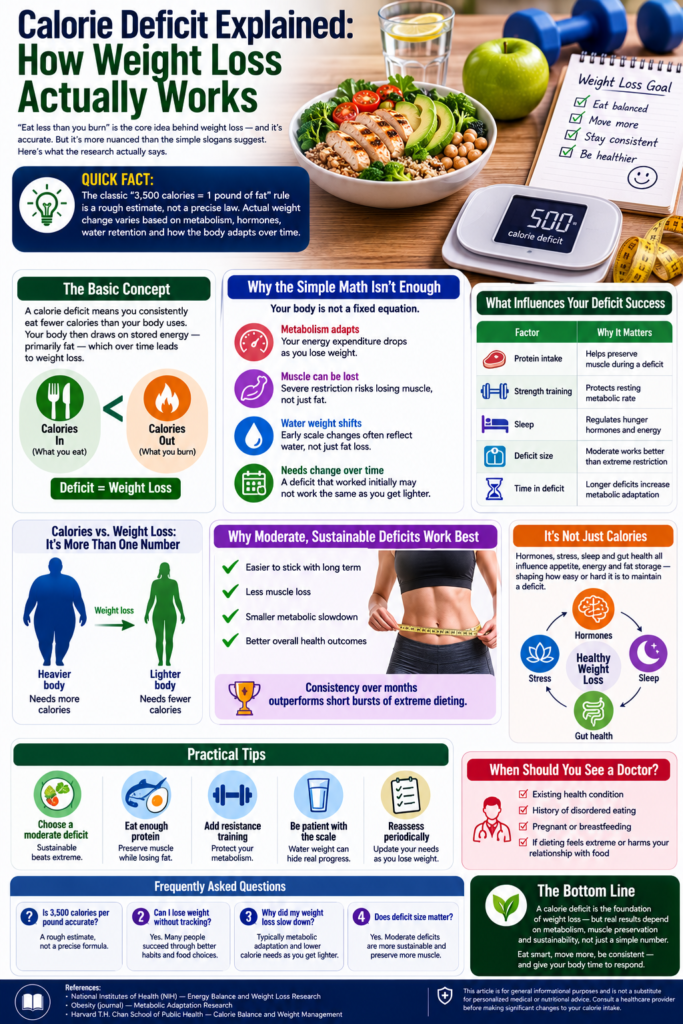
Quick Fact: The classic “3,500 calories = 1 pound of fat” rule is a rough estimate, not a precise law — actual weight change varies based on metabolism, hormones, water retention, and how the body adapts to sustained calorie restriction over time.
The Basic Concept
A calorie deficit simply means consuming fewer calories than your body uses for energy. When intake is consistently lower than expenditure, your body draws on stored energy — primarily fat — to make up the difference, which over time results in weight loss. This is genuinely the underlying mechanism behind essentially every weight loss approach, regardless of whether it’s branded as keto, intermittent fasting, or a specific diet plan — they all work, to the extent they work, by creating some form of calorie deficit.
Why the Simple Math Doesn’t Tell the Whole Story
The old rule of thumb — cut 500 calories a day for a 1-pound-per-week loss — treats the body like a fixed equation. In reality, several things complicate that math:
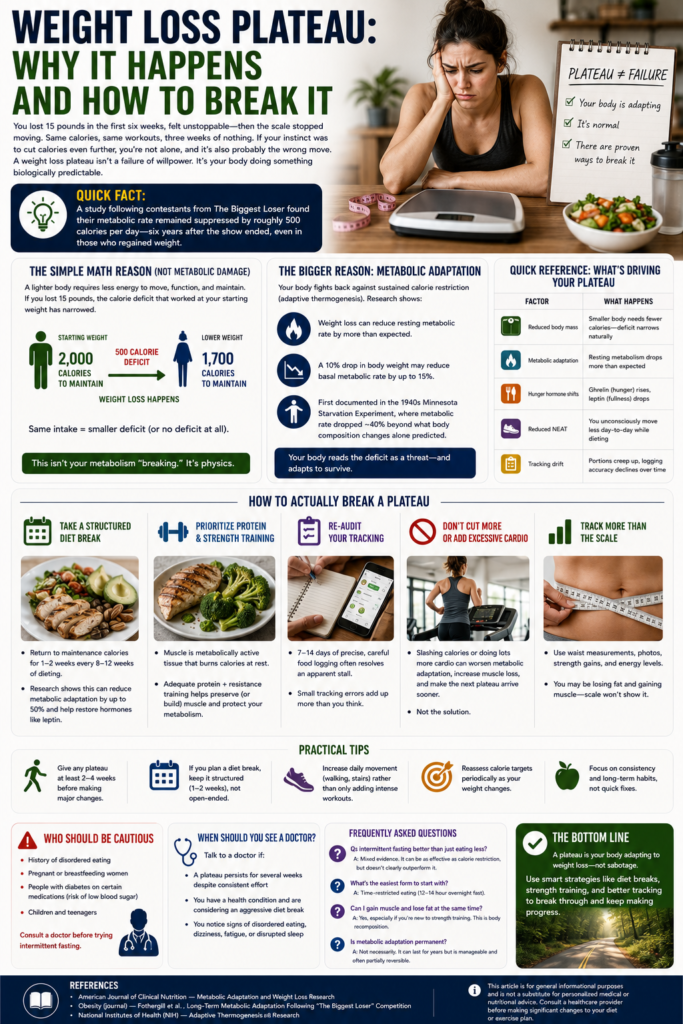
Your metabolism adapts. As covered in research on weight loss plateaus, your body’s energy expenditure drops as you lose weight — partly because a smaller body needs less energy, and partly through metabolic adaptation, where the body becomes more efficient at conserving energy than expected. A deficit that worked at a higher weight often doesn’t represent the same deficit anymore after meaningful weight loss.
Not all deficits affect the body the same way. A deficit created mostly through severe calorie restriction tends to increase the risk of losing muscle along with fat, while a more moderate deficit combined with adequate protein and strength training tends to preserve more lean mass.
Water weight muddies short-term results. Especially in the first weeks of a new eating pattern, scale changes often reflect shifts in water retention (particularly with changes in carbohydrate or sodium intake) as much as actual fat loss, which is part of why early rapid drops in weight aren’t a reliable predictor of the pace going forward.
Quick Reference: What Actually Influences Deficit Effectiveness
| Factor | Why It Matters |
|---|---|
| Deficit size | Very large deficits increase muscle loss risk and adaptation |
| Protein intake | Higher protein helps preserve muscle during a deficit |
| Strength training | Helps protect resting metabolic rate |
| Sleep | Poor sleep affects hunger hormones and deficit adherence |
| Time in deficit | Longer sustained deficits increase metabolic adaptation |
Why Moderate, Sustainable Deficits Tend to Work Better
Very aggressive calorie restriction often backfires in practice — it’s harder to sustain, more likely to trigger a stronger metabolic slowdown, and more likely to result in muscle loss alongside fat loss. A moderate, sustainable deficit — paired with adequate protein and some resistance training — is generally associated with better long-term outcomes than extreme restriction, even though it produces slower week-to-week results on the scale.
Beyond “Calories In, Calories Out”: What Else Is Involved
While the calorie deficit remains the core mechanism, hormones (like insulin and leptin), sleep quality, stress levels, and even gut microbiome composition all influence appetite, energy expenditure, and how readily your body holds onto or releases stored fat. None of these replace the calorie deficit as the underlying driver, but they meaningfully affect how easy or hard it is to sustain one, and how your body responds to it.
If you’re considering meal timing strategies, it’s worth reading whether intermittent fasting actually delivers on its weight loss claims.
Practical Tips
- Favor a moderate, sustainable deficit over an aggressive one — consistency over months tends to outperform short bursts of severe restriction.
- Prioritize protein and some resistance training if preserving muscle matters to you, since a deficit alone doesn’t distinguish between burning fat and burning muscle.
- Don’t judge progress by the scale alone in the first couple of weeks — water weight shifts can obscure the actual trend.
- Revisit your approach periodically rather than assuming a deficit that worked initially will keep working indefinitely as your weight changes.
If you’re building out a full plan, it’s worth pairing this with our guides on 10 science-backed ways to lose weight naturally and breaking a weight loss plateau, since both build directly on the calorie deficit concept covered here.
When Should You See a Doctor?
Talk to a doctor or registered dietitian before starting a significant calorie deficit if you have an existing health condition, a history of disordered eating, or are pregnant or breastfeeding. It’s also worth professional guidance if weight loss efforts consistently feel extreme, restrictive, or are affecting your relationship with food, rather than working through those patterns alone.
Frequently Asked Questions
Is the “3,500 calories per pound” rule accurate? It’s a rough approximation, not a precise formula. Real-world weight change is influenced by metabolic adaptation, water retention, and individual variation, so actual results often differ from the simple math.
Does the size of my calorie deficit matter? Yes — very large deficits tend to increase the risk of muscle loss and a stronger metabolic slowdown, while moderate deficits are generally easier to sustain and more likely to preserve muscle mass.
Can I lose weight without tracking calories precisely? Yes. Many people achieve a calorie deficit through consistent habits — more protein and fiber, less processed food, more movement — without precise tracking, though tracking can help some people stay accountable.
Why did my weight loss slow down even though I didn’t change anything? This is typically metabolic adaptation and the natural narrowing of your deficit as your body gets lighter — not a sign that something is wrong, but a signal that your calorie needs have changed along with your weight.
If you’ve experienced repeated diet and regain cycles, it’s worth reading whether weight cycling is actually as harmful as commonly believed.
The Bottom Line
A calorie deficit is genuinely the foundational mechanism behind weight loss, but it’s not the simple, fixed equation it’s often presented as. Metabolic adaptation, muscle preservation, and sustainability all shape how effectively — and how comfortably — a deficit actually translates into lasting results.
This article is for general informational purposes and is not a substitute for personalized medical or nutritional advice. Consult a healthcare provider or registered dietitian before making significant changes to your calorie intake, especially if you have an existing health condition or history of disordered eating.
References
- National Institutes of Health (NIH) — Energy Balance and Weight Loss Research
- Obesity (journal) — Metabolic Adaptation Research
- Harvard T.H. Chan School of Public Health — Calorie Balance and Weight Management