HIIT workouts — short for high-intensity interval training — have topped fitness trend surveys for years, and for good reason: research consistently shows they deliver many of the same benefits as much longer sessions, in a fraction of the time., and for good reason: research consistently shows it delivers many of the same benefits as much longer workouts, in a fraction of the time. Here’s what HIIT actually is, what the research says, and how to start safely.
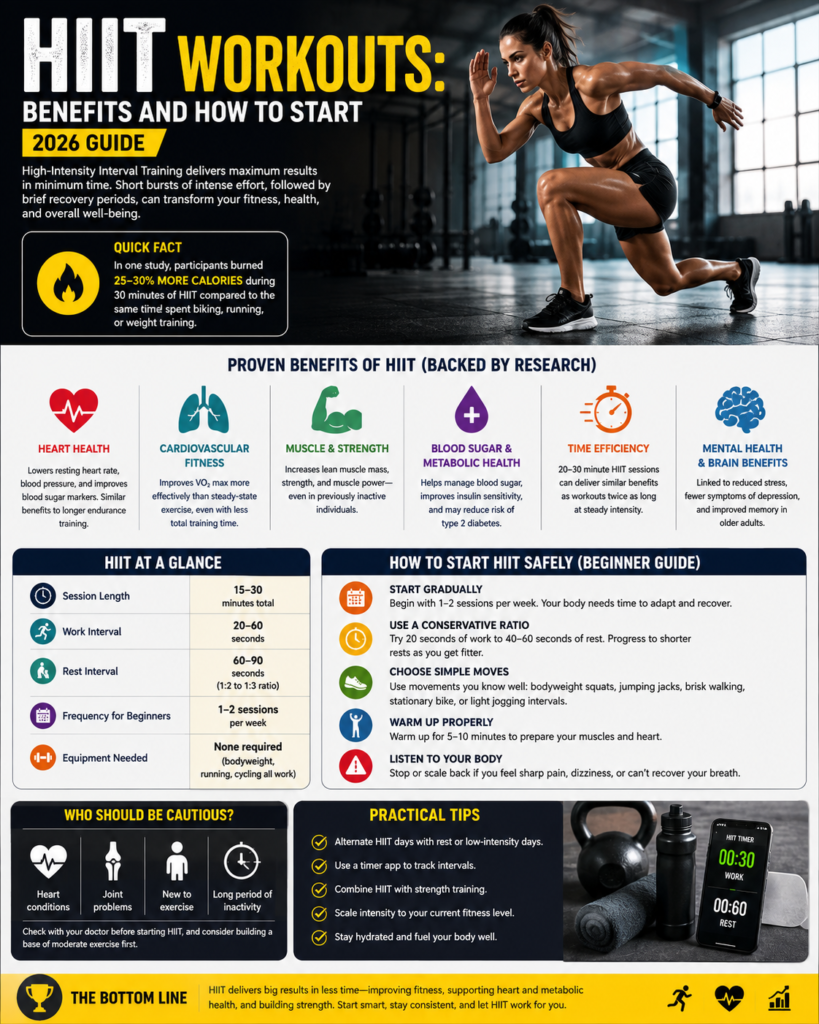
Quick Fact: In one study, participants burned 25-30% more calories during 30 minutes of HIIT compared to the same amount of time spent biking, running, or weight training.
What Are HIIT Workouts, Exactly?
HIIT alternates short bursts of near-maximum effort with brief recovery periods. A typical structure might be 30 seconds of all-out effort followed by 60-90 seconds of rest or light movement, repeated for 15-20 minutes total. The work-to-rest ratio and total session length can vary widely, which is part of what makes HIIT adaptable to almost any fitness level and activity — sprinting, cycling, bodyweight circuits, or a stationary bike.
What the Research Shows
Heart health. A summary of 50 studies found that HIIT led to lower resting heart rate, lower blood pressure, and improved blood sugar markers. In one trial, participants doing HIIT three times a week for 20 minutes achieved blood pressure improvements comparable to a group doing longer endurance training four times a week.
Cardiovascular fitness (VO2 max). Research indicates HIIT may improve VO2 max — a key measure of cardiovascular fitness — more effectively than steady-state moderate exercise, even with less total training time.
Muscle and strength. In one study, previously inactive middle-aged men saw increased lean muscle mass and strength after just 3 weeks of HIIT, along with improvements in muscle power.
Blood sugar and metabolic health. HIIT has been shown to help with blood sugar management, including in people with type 2 diabetes, and may reduce the risk of developing the condition in the first place.
Time efficiency. Multiple studies suggest 20-30 minute HIIT sessions can produce health benefits comparable to workouts roughly twice as long at moderate, steady intensity — a significant advantage for people with limited time.
Mental health and cognitive benefits. Beyond the physical effects, some research links HIIT to reduced stress and fewer symptoms of depression, and small studies have even found interval training improved memory in older adults more than steady-state exercise alone.
Quick Reference: HIIT at a Glance
| Factor | Typical Range |
|---|---|
| Session length | 15–30 minutes total |
| Work interval | 20–60 seconds near-maximum effort |
| Rest interval | 60–90 seconds (roughly 1:2 to 1:3 ratio) |
| Frequency for beginners | 1–2 sessions per week to start |
| Equipment needed | None required (bodyweight, running, cycling all work) |
How to Start HIIT Safely as a Beginner
Start with 1-2 sessions per week, not daily. HIIT is demanding on your body, and building up gradually reduces injury risk and allows adequate recovery between sessions.
Use a conservative work-to-rest ratio at first, such as 20 seconds of effort to 40-60 seconds of rest, rather than jumping straight into aggressive 1:1 ratios used by more experienced exercisers.
Choose familiar movements. Bodyweight squats, jumping jacks, brisk intervals of walking or jogging, or a stationary bike are all reasonable starting points that don’t require learning complex new skills under fatigue.
Warm up properly. Because HIIT pushes your heart rate up quickly, a 5-10 minute warm-up matters more here than in steady, moderate-intensity workouts.
Know the signs you’re pushing too hard, too soon. Sharp pain (different from normal muscle fatigue), dizziness, or an inability to recover your breath between intervals are signs to scale back intensity or rest longer.
Who Should Be Cautious With HIIT
HIIT is demanding on both the heart and joints. If you have an existing heart condition, joint problems, are new to exercise entirely, or haven’t been active in a long time, check with a doctor before starting, and consider building a base of moderate exercise first.
Practical Tips
- Alternate HIIT days with lower-intensity or rest days — back-to-back HIIT sessions without recovery increase injury risk and reduce the quality of each workout.
- Track your intervals with a simple timer app rather than guessing at effort and rest periods.
- Combine HIIT with regular strength training rather than replacing it entirely, since HIIT alone doesn’t build muscle to the same degree as dedicated resistance work.
- Scale intensity to your current fitness level — “near-maximum effort” looks different for a beginner than for someone who’s trained for years.
If you’re building a complete fitness routine, it’s worth pairing this with our guides on strength training for beginners and cardio vs strength training, since HIIT fits into the broader picture of balancing cardio and resistance work.
Frequently Asked Questions
Is HIIT better than regular cardio for weight loss? HIIT tends to burn more calories per minute and offers time efficiency, but consistency matters more than which type you choose. The best approach is the one you can sustain regularly.
Can beginners really do HIIT safely? Yes, with appropriate modifications — lower intensity, longer rest periods, and fewer weekly sessions. HIIT is adaptable to fitness level; it doesn’t require starting at an advanced intensity.
How often should I do HIIT each week? Most guidance suggests 1-3 sessions per week for most people, with rest or lower-intensity days in between to allow recovery.
Does HIIT replace the need for strength training? Not entirely. HIIT can include strength elements, but dedicated resistance training remains more effective for building significant muscle mass and strength over time.
The Bottom Line
HIIT workouts offer a genuinely time-efficient way…-efficient way to improve cardiovascular fitness, support blood sugar and blood pressure, and build some strength — often in workouts as short as 15-20 minutes. Starting conservatively, with adequate rest between sessions, lets beginners access these benefits without unnecessary injury risk.
This article is for general informational purposes and is not a substitute for personalized medical or fitness advice. Consult a healthcare provider before starting HIIT, especially if you have an existing heart or joint condition.
References
- Medical News Today — HIIT Benefits and How to Start
- ParticipACTION — HIIT Benefits and Tips for Beginners
- National Institutes of Health (NIH) — Interval Training Research