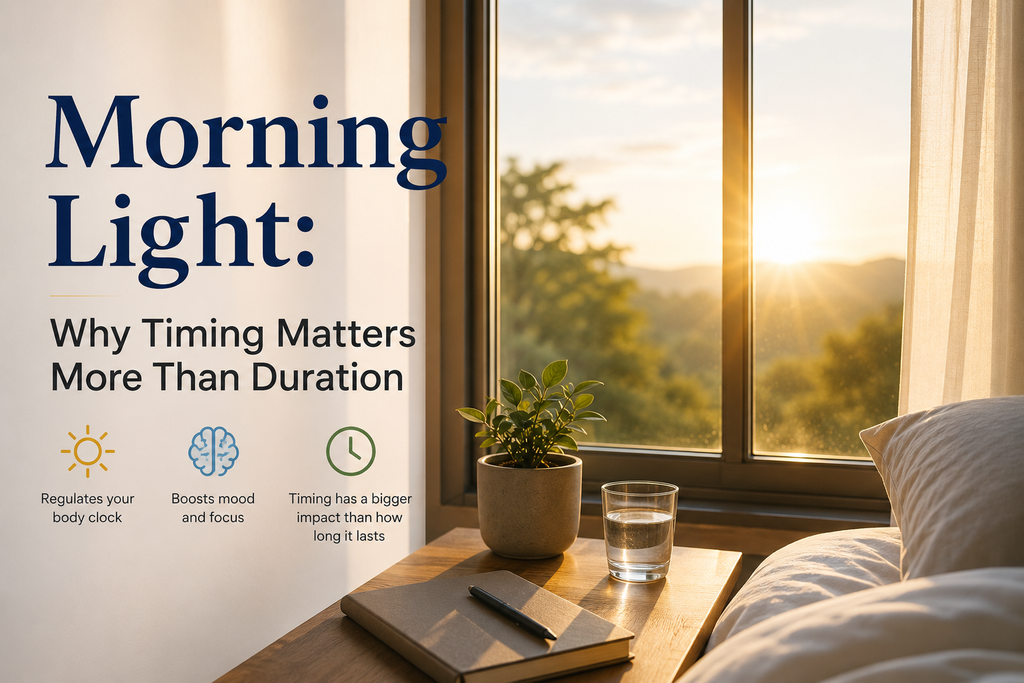
Most advice about sunlight treats it as a single thing — get more of it, feel better. The research says something more specific and more useful: when you get light largely determines whether it helps or hurts.
The same brightness that resets your clock forward at 7 a.m. pushes it backward at 10 p.m. Light isn’t neutral. Its effect flips direction depending on the hour.
Quick Fact: A 2025 study of 1,762 adults found that every additional 30 minutes of morning sunlight before 10 a.m. was associated with a 23-minute earlier sleep midpoint — a measurable shift in circadian alignment from a modest amount of morning light.
The Phase Response Curve
This is the concept that makes everything else make sense, and almost nobody outside sleep research knows it.
Your circadian clock responds to light differently depending on when the light hits:
- Early morning (roughly 6 a.m. to noon) — light advances your clock. You get sleepy earlier and wake earlier.
- Middle of the day — minimal circadian effect. Researchers call this the “dead zone” for phase shifting.
- Evening (roughly 6 p.m. to midnight) — light delays your clock. You stay up later and wake later.
The magnitudes are substantial. Research on single bright light pulses found phase shifts ranging from 30 minutes to 3 hours depending purely on timing — with the largest delays from light around 10-11 p.m. and the largest advances from light around 4-5 a.m.
Same light. Opposite effects. That’s the part most “get more sunlight” advice misses entirely.
Quick Reference: Light Timing Effects
| Time of Day | Effect on Circadian Clock | Practical Result |
|---|---|---|
| ~6 a.m. – noon | Phase advance | Sleepy earlier, wake earlier |
| Midday | Minimal (“dead zone”) | Improves daytime alertness |
| ~6 p.m. – midnight | Phase delay | Stay up later, wake later |
| During sleep | Suppresses melatonin | Fragmented sleep |
Why Indoor Light Doesn’t Count
This is where most people’s mental model breaks down.
Direct sunlight reaches up to 10,000 lux. A well-lit office is typically around 500 lux. Your eyes adapt so effectively that both feel “bright” — but from your circadian system’s perspective, they’re not remotely comparable.
That gap explains a common pattern: someone works near a window all day, feels like they get plenty of light, and still has a drifting sleep schedule. Their circadian system has been receiving a fraction of what it needs.
A study using wearable light sensors on UK adults found exactly this — participants were frequently exposed to less light during the day and more light before bed and during sleep than recommended. Modern indoor life inverts the pattern the circadian system evolved for.
How the Signal Actually Works
Light enters your eye and is detected by specialized retinal cells — separate from the ones that produce vision. These melanopsin-containing cells send signals to the suprachiasmatic nucleus (SCN) in the hypothalamus, the master clock.
The SCN then coordinates timing across virtually every cell in your body. Each cell has its own clock, regulated by genes with names like PER, BMAL, and CLOCK. That’s why circadian alignment affects far more than sleep — it touches hormone secretion, body temperature, metabolism, and alertness.
Morning light does two things simultaneously: it advances the clock, and it triggers a healthy cortisol rise that supports morning alertness. Evening light does the reverse — it suppresses melatonin, the hormone that signals darkness has arrived.
What the Recent Research Shows
Sleep quality. A daily diary study following 103 adults for up to 70 days found that the timing of sunlight exposure predicted next-night sleep quality — morning sunlight specifically predicted better sleep. Notably, duration was generally not associated with sleep quality.
Circadian alignment. The 2025 Brazilian study found sleep midpoint was the sleep parameter most affected by sunlight, with morning exposure showing the strongest association.
Real-world effects. One study found that when people simply let natural light into their apartments for a week, they fell asleep 22 minutes earlier, slept more regularly, and reported better mood and alertness compared to a week with blinds closed.
Mood and anxiety. A study of 700 people during the pandemic found that those spending 1-2 hours outdoors daily, or working in brightly lit rooms, were less likely to report sleep trouble or anxiety.
What People Actually Get Wrong
The most common misconception is that more light is better. The research on duration is genuinely mixed — timing showed stronger and more consistent effects than total exposure time in multiple studies.
The second issue is sunglasses in the morning. Wearing them during your morning walk substantially reduces the signal reaching the eye. Research on light behaviors found that less use of blue-blocking eyewear outdoors during the day predicted earlier circadian timing — the opposite of what many people assume.
Third, and most underestimated: the commute used to do this automatically. Walking to a train, biking to work, standing outside — these delivered morning light without anyone thinking about it. Remote work replaced that with a walk from bedroom to desk. As one researcher put it, people are missing that morning light without realizing anything changed.
A practical note that helps: cloudy days still work. Overcast outdoor light typically remains far brighter than indoor lighting, so a gray morning outside beats a bright room inside.
Common Mistakes
Treating any light as equivalent. Indoor lighting is roughly one-twentieth the intensity of direct sunlight. Sitting near a window is not the same as being outside.
Wearing sunglasses on a morning walk. This blocks the exact signal you’re trying to deliver. Save them for midday sun.
Focusing on duration instead of timing. Fifteen minutes at 7 a.m. does more for circadian alignment than an hour at 2 p.m.
Getting bright light in the evening. Screens and bright overhead lighting after dark actively delay your clock — undoing morning gains.
Assuming cloudy days don’t count. Overcast daylight is still substantially brighter than indoor light and remains effective.
Expecting immediate results. Circadian shifts accumulate over days. A single morning outside won’t fix a schedule that drifted over months.
Practical Tips
- Get outside within the first 30-60 minutes after waking, even briefly — this is the highest-leverage window.
- Aim for 15-30 minutes in the morning; go longer on overcast days since intensity is lower.
- Skip sunglasses during morning light exposure, but wear them during peak midday sun.
- Dim overhead lights and reduce screen brightness in the two hours before bed to avoid working against your morning exposure.
- Pair morning light with something you already do — coffee outside, a short walk, or eating breakfast near an open door.
If you’re working on sleep more broadly, it’s worth pairing this with our guides on sleeping better naturally and screen time and mental health, since evening light exposure is where most morning progress gets undone.
When Should You See a Doctor?
Talk to a doctor if sleep problems persist despite consistent light exposure and good sleep habits, or if you suspect a circadian rhythm disorder — patterns where your sleep timing is shifted dramatically from your desired schedule. Light therapy using a specialized lamp is a documented treatment for several circadian disorders, but timing and intensity should be guided by a professional rather than guessed at. Also seek guidance before using bright light therapy if you have bipolar disorder or a retinal condition.
Frequently Asked Questions
How long do I need to be in morning light? Research suggests 15-30 minutes shortly after waking is meaningful, and multiple studies found timing mattered more than duration for sleep outcomes.
Does light through a window work? Partially, but far less effectively. Window glass and indoor positioning reduce intensity substantially compared to being outdoors — the difference between roughly 500 lux and up to 10,000 lux.
What if it’s cloudy where I live? Overcast outdoor light is still typically much brighter than indoor lighting and remains effective, though slightly longer exposure may help.
Can I use a light therapy lamp instead of sunlight? Yes, light therapy lamps are an established approach, particularly in regions with limited winter daylight. For treating a diagnosed circadian disorder, timing and intensity should be determined with a healthcare provider.
The Bottom Line
Light is the strongest signal your body clock receives, and its effect reverses depending on when you get it. Morning light pulls your schedule earlier; evening light pushes it later. The research consistently points to timing over duration — a short walk outside shortly after waking does more for circadian alignment than hours of indoor light later. And the biggest modern problem isn’t too little light overall; it’s getting too little when it counts and too much when it doesn’t.
This article is for general informational purposes and is not a substitute for personalized medical advice. Consult a healthcare provider for persistent sleep problems or before starting light therapy.
References
- Sleep Foundation — Light and Sleep: Effects on Sleep Quality
- BMC Public Health — The Role of Sunlight in Sleep Regulation (2025)
- CDC/NIOSH — Effects of Light on Circadian Rhythms