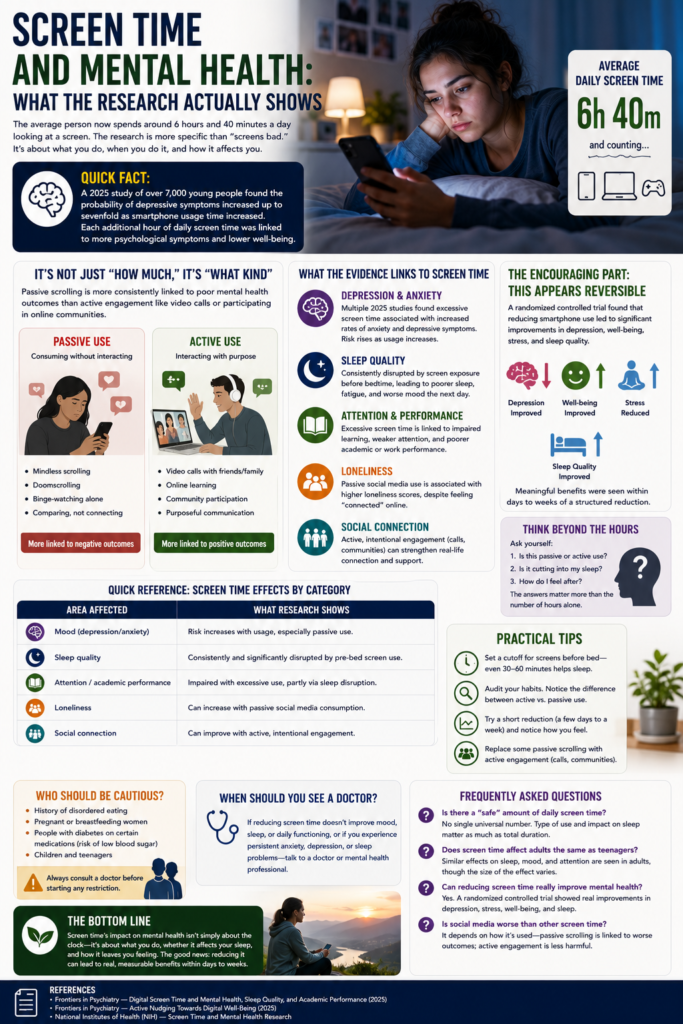
Screen time and mental health are more connected than most people realize. The average person now spends around 6 hours and 40 minutes a day looking at a screen — but that number alone doesn’t tell you much about what it’s doing to your wellbeing.. That number alone doesn’t tell you
much — but the research on what that time is doing to mental health has gotten considerably more specific in the last couple of years, and it’s not simply “screens bad.”
Quick Fact: A 2025 study of over 7,000 young people found the probability of depressive symptoms increased up to sevenfold as smartphone usage time increased, with each additional hour of daily screen time linked to a stepwise rise in psychological symptoms and a decline in well-being.
It’s Not Just “How Much,” It’s “What Kind”
One of the more consistent findings across recent research is that screen time isn’t a single, uniform activity. Passive scrolling — consuming content without interacting — is more consistently linked to poor mental health outcomes than active engagement, like video calls with friends or participating in an online community. This distinction matters more than the raw hour count: two people with identical screen time totals can have very different experiences depending on what that time is spent doing.
What the Evidence Actually Links to Screen Time
Depression and anxiety. Multiple 2025 studies found excessive screen time associated with increased rates of anxiety and depressive symptoms, with the relationship appearing to intensify as usage climbs — not a fixed threshold effect, but a gradual one.
Sleep quality. This is one of the most consistently documented effects. Screen exposure before bedtime is linked to compromised sleep quality, which in turn contributes to fatigue, mood disturbances, and reduced cognitive function the following day — a domino effect that touches nearly every other outcome on this list.
Attention and academic or work performance. Research among university students found excessive digital screen time associated with impaired learning ability, weaker critical thinking performance, and poorer academic outcomes — plausibly connected to the sleep disruption above as much as the screen use itself.
Loneliness, despite more “connection.” Somewhat counterintuitively, some research finds screen time associated with increased loneliness scores, particularly when use is passive rather than genuinely social.
Quick Reference: Screen Time Effects by Category
| Area Affected | What Research Shows |
|---|---|
| Mood (depression/anxiety) | Risk increases with usage, especially passive use |
| Sleep quality | Consistently and significantly disrupted by pre-bed screen use |
| Attention/academic performance | Impaired with excessive use, partly via sleep disruption |
| Loneliness | Can increase with passive social media consumption |
| Social connection | Can improve with active, intentional engagement |
The Encouraging Part: This Appears Reversible
A randomized controlled trial specifically testing smartphone use reduction found significant improvements in depression, well-being, stress, and sleep quality from reducing screen time — not just an association, but a causal intervention with a measurable result. This matters because it suggests the relationship isn’t fixed; deliberately dialing back usage produces real, measurable benefits within the study period, not just a theoretical one.
A Practical Way to Think About Your Own Screen Time
Rather than fixating on a single “healthy” number of hours, the research points toward three more useful questions: Is this passive or active use? Is it displacing sleep? And does it leave you feeling better or worse afterward? Someone who spends two hours on a video call with family is having a very different experience than someone spending two hours passively scrolling — even though both count as “two hours of screen time.”
Practical Tips
- Set a cutoff for screens before bed — even 30-60 minutes of a screen-free wind-down measurably helps sleep quality in the research.
- Notice the difference between active and passive use in your own habits; a quick honest audit often reveals more passive scrolling than people initially assume.
- Try a short, structured reduction (a few days to a week) and notice how mood and sleep respond — the RCT evidence suggests even brief interventions can produce real change.
- Replace some passive scrolling with active engagement (a call instead of a feed) rather than trying to eliminate screen time altogether, which tends to be more sustainable.
If you’re working on your broader mental wellness, it’s worth pairing this with our guides on sleeping better naturally and stress management techniques, since sleep and stress are two of the main pathways screen time appears to affect.
When Should You See a Doctor?
If reducing screen time on your own doesn’t meaningfully improve mood, sleep, or daily functioning, or if you notice signs of significant anxiety or depression regardless of screen habits, it’s worth talking to a doctor or mental health professional rather than assuming screen time is the sole factor at play.
Frequently Asked Questions
Is there a “safe” amount of daily screen time? There’s no single universal number in the research; the type of use (passive vs. active) and its effect on sleep appear to matter as much as total duration.
Does screen time affect adults the same way it affects teenagers? Much of the strongest research focuses on adolescents, who show particularly clear associations, but studies in adults show similar directional effects on sleep, mood, and attention, even if the size of the effect varies.
Can reducing screen time actually improve mental health, or is it just correlation? Both. Observational studies show the association, but a randomized controlled trial specifically testing reduced smartphone use found real improvements in depression, stress, well-being, and sleep — evidence of an actual causal effect, not just a pattern.
Is social media worse than other types of screen time? Research suggests the way social media is used matters more than the platform itself — passive scrolling tends to correlate with worse outcomes than active social engagement through the same apps.
The Bottom Line
Screen time’s effect on mental health isn’t simply about the clock — it’s about what kind of use it is, whether it’s cutting into sleep, and how it leaves you feeling afterward. The research is genuinely encouraging on one point: unlike some risk factors, this one responds measurably to change within days to weeks of a deliberate reduction.
This article is for general informational purposes and is not a substitute for personalized mental health advice. If you’re experiencing persistent anxiety, depression, or sleep problems, consider speaking with a doctor or mental health professional.
References
- Frontiers in Psychiatry — Digital Screen Time and Mental Health, Sleep Quality, and Academic Performance (2025)
- Frontiers in Psychiatry — Active Nudging Towards Digital Well-Being (2025)
- National Institutes of Health (NIH) — Screen Time and Mental Health Research