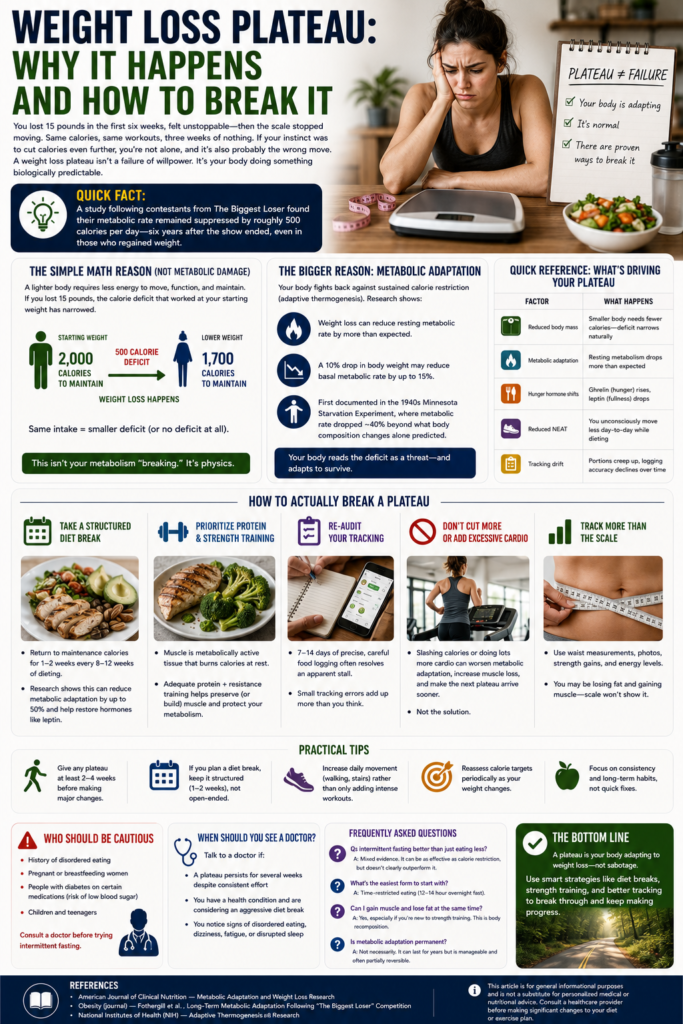
You lost 15 pounds in the first six weeks, felt unstoppable — then the scale stopped moving. Same calories, same workouts, three weeks of nothing. If your instinct was to cut calories even further, you’re not alone, and it’s also probably the wrong move. A weight loss plateau isn’t a failure of willpower. It’s your body doing something biologically predictable.
Quick Fact: A study following contestants from The Biggest Loser found their metabolic rate remained suppressed by roughly 500 calories per day — six years after the show ended, even in those who regained weight.
The Simple Math Reason (Not Metabolic Damage)
Part of every plateau is just physics. A lighter body requires less energy to move, function, and maintain than a heavier one did. If you lost 15 pounds, the calorie deficit that worked at your starting weight has quietly narrowed — the same intake that once created a real deficit may now sit much closer to your new maintenance level. This isn’t your metabolism “breaking.” It’s a predictable consequence of successfully losing weight.
The Bigger Reason: Metabolic Adaptation
Beyond the basic math, your body actively fights back against sustained calorie restriction — a phenomenon called metabolic adaptation, or adaptive thermogenesis. Research suggests weight loss can reduce resting metabolic rate by more than expected based on lost body mass alone; one study found a 10% drop in body weight reduced basal metabolic rate by up to 15%. Your body isn’t interpreting the deficit as progress — physiologically, it reads more like a threat to respond to and correct.
This isn’t a fringe idea. It was first systematically documented during the Minnesota Starvation Experiment in the 1940s, where researchers observed metabolic rates dropping roughly 40% beyond what body composition changes alone would predict.
Quick Reference: What’s Driving Your Plateau
| Factor | What Happens |
|---|---|
| Reduced body mass | Smaller body needs fewer calories — deficit narrows naturally |
| Metabolic adaptation | Resting metabolism drops more than expected |
| Hunger hormone shifts | Ghrelin (hunger) rises, leptin (fullness) drops |
| Reduced NEAT | You unconsciously move less day-to-day while dieting |
| Tracking drift | Portions creep up, logging accuracy declines over time |
It’s Not Just Metabolism — Hormones and Habits Shift Too
Weight loss changes appetite-regulating hormones: ghrelin (which drives hunger) tends to rise, while leptin (which signals fullness) drops as body fat decreases. On top of that, NEAT — non-exercise activity thermogenesis, the calories burned through fidgeting, walking, and general daily movement — often quietly declines while dieting, without you consciously deciding to move less. One often-overlooked factor: research suggests early plateaus are frequently driven more by small tracking inconsistencies (portions creeping up, forgotten snacks) than by metabolism alone — worth ruling out before assuming it’s purely biological.
How to Actually Break a Plateau
Take a structured diet break. Returning to maintenance calories for 1-2 weeks every 8-12 weeks of dieting has been shown in research to reduce metabolic adaptation by as much as 50%, while helping restore hormones like leptin. This isn’t “falling off the wagon” — it’s a deliberate strategy.
Prioritize protein and strength training. Muscle is metabolically active tissue that burns calories even at rest. Preserving (or building) muscle during weight loss — through adequate protein intake and resistance training — helps protect your resting metabolic rate rather than letting it decline alongside fat loss.
Re-audit your tracking. Seven to fourteen days of precise, careful food logging often resolves an apparent stall on its own, since portion creep and forgotten extras are extremely common after weeks of dieting.
Resist the urge to cut calories further or add excessive cardio. This is consistently flagged as the wrong response: slashing intake or dramatically increasing cardio from an already-depleted position tends to worsen metabolic adaptation, increase muscle loss, and make the next plateau arrive sooner.
Track more than the scale. Waist measurements, progress photos, training performance, and energy levels can reveal real progress — including body recomposition (losing fat while gaining muscle) — that the scale alone won’t show.
Practical Tips
- Give any single plateau at least 2-4 weeks before making major changes; short-term stalls are normal and often resolve on their own.
- If you plan a diet break, keep it structured (a set 1-2 week window) rather than open-ended, so it doesn’t drift into abandoning your goals.
- Increase daily movement (walking, taking stairs) rather than only adding intense workouts, since NEAT decline is often an under-addressed piece of the puzzle.
- Reassess your calorie targets periodically as your weight changes — the deficit that worked at a higher weight likely needs recalculating at a lower one.
If you’re troubleshooting a broader weight loss plan, it’s worth pairing this with our guides on 10 science-backed ways to lose weight naturally and strength training for beginners, since muscle preservation is one of the more effective plateau-prevention strategies.
When Should You See a Doctor?
Talk to a doctor if a plateau persists for more than several weeks despite consistent effort and troubleshooting, if you’re considering an aggressive diet break or refeed strategy and have an existing health condition, or if you notice signs of disordered eating patterns emerging in response to frustration with stalled progress.
Frequently Asked Questions
How long is a normal weight loss plateau? A plateau is generally defined as a stall of 2-4 weeks despite consistent diet and exercise. Shorter stalls are common and often resolve without any specific intervention.
Should I eat less when I hit a plateau? Usually not as a first response. Research suggests further calorie cutting tends to worsen metabolic adaptation rather than resolve it — a diet break or improved tracking accuracy is typically a better first step.
Can I really be gaining muscle and losing fat at the same time? Yes, particularly for people newer to strength training. This is called body recomposition, and it can mean the scale stalls even while meaningful physical changes are happening.
Is metabolic adaptation permanent? Research, including long-term follow-up of Biggest Loser contestants, suggests suppression can persist for years, but it’s generally considered manageable and often partially reversible with strategies like diet breaks and strength training, rather than a fixed, permanent state.
The Bottom Line
A weight loss plateau isn’t sabotage, and it isn’t proof you’re doing something wrong — it’s your body responding to sustained calorie restriction in a predictable, well-documented way. Structured diet breaks, protecting muscle mass, and re-checking tracking accuracy consistently outperform the instinct to simply eat less and push harder.
This article is for general informational purposes and is not a substitute for personalized medical or nutritional advice. Consult a healthcare provider or registered dietitian before making significant changes to an existing weight loss plan.
References
- American Journal of Clinical Nutrition — Metabolic Adaptation and Weight Loss Research
- Obesity (journal) — Fothergill et al., Long-Term Metabolic Adaptation Following “The Biggest Loser” Competition
- National Institutes of Health (NIH) — Adaptive Thermogenesis Research